


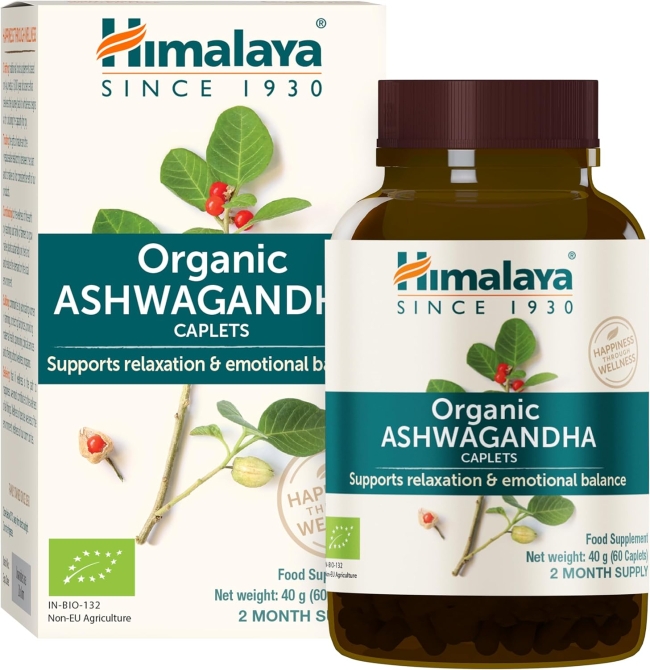



Ashwagandha (Withania somnifera), also known as Indian ginseng, is one of the most popular herbs in Ayurveda and one of the most extensively studied adaptogens. However, choosing a product can easily become confusing: 300 mg, 600 mg, powder, extract, standardized extract… What dose should you actually take? Morning or evening? And for how long? Scientific research provides some useful guidance.
How much ashwagandha should you take per day?
There is no single universal dose because root powder and different extracts are not equivalent.
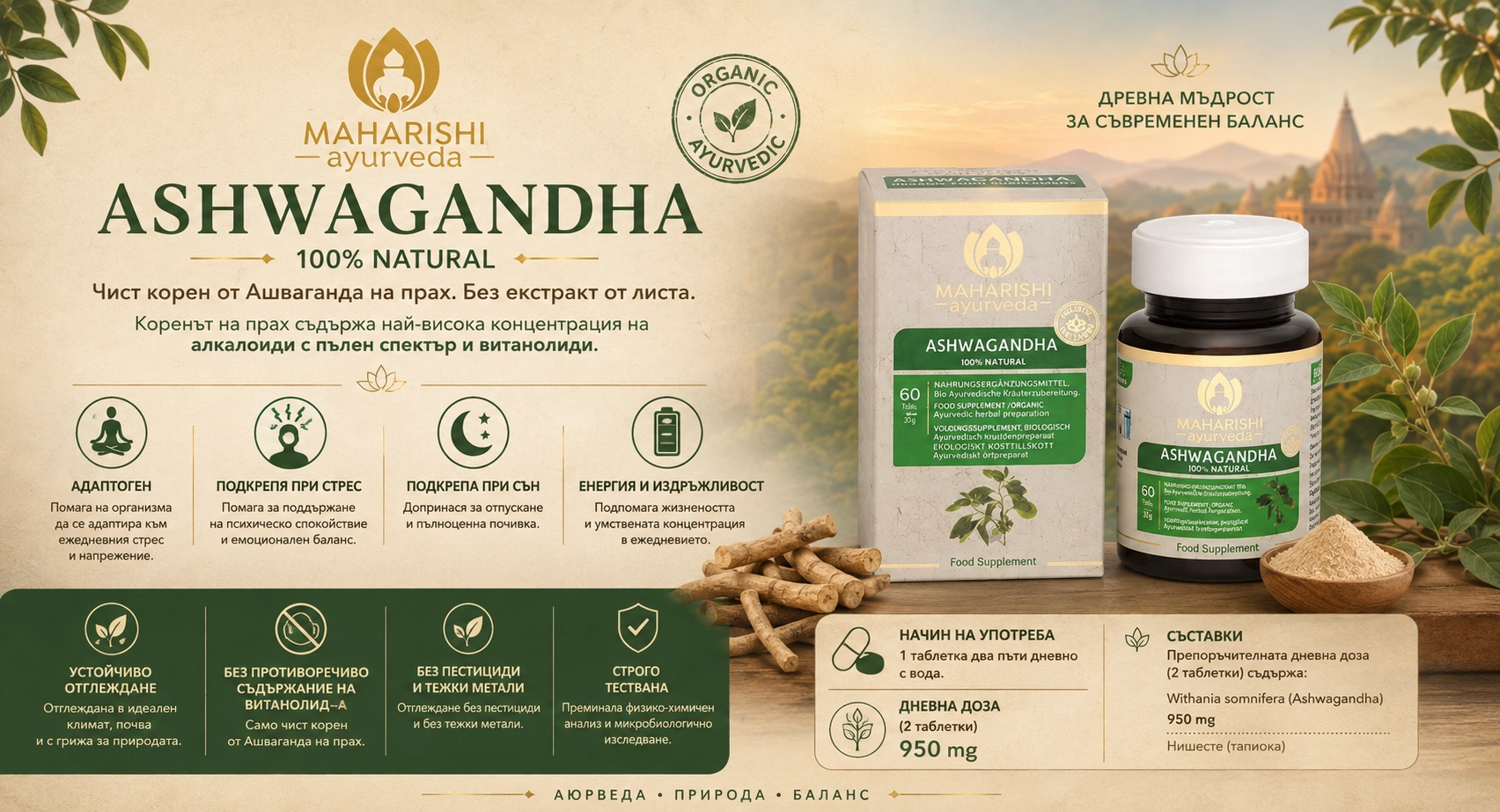
In clinical studies using standardized extracts, doses of around 250–600 mg per day are commonly seen. In studies on stress, 600 mg per day, usually divided into two 300 mg doses, has been particularly well studied. In some studies, results with 500–600 mg per day were more pronounced than with lower doses.
With traditional ashwagandha root powder, the amounts are considerably higher and are measured in grams. Scientific studies have investigated amounts equivalent to approximately 6 g of root powder per day.
This does not mean that everyone should take these exact amounts. They are reference points from clinical studies, while the appropriate dose of a specific product should take its composition and concentration into account.
Ashwagandha powder or extract?
This is a more important question than simply asking, “How many milligrams does it contain?”
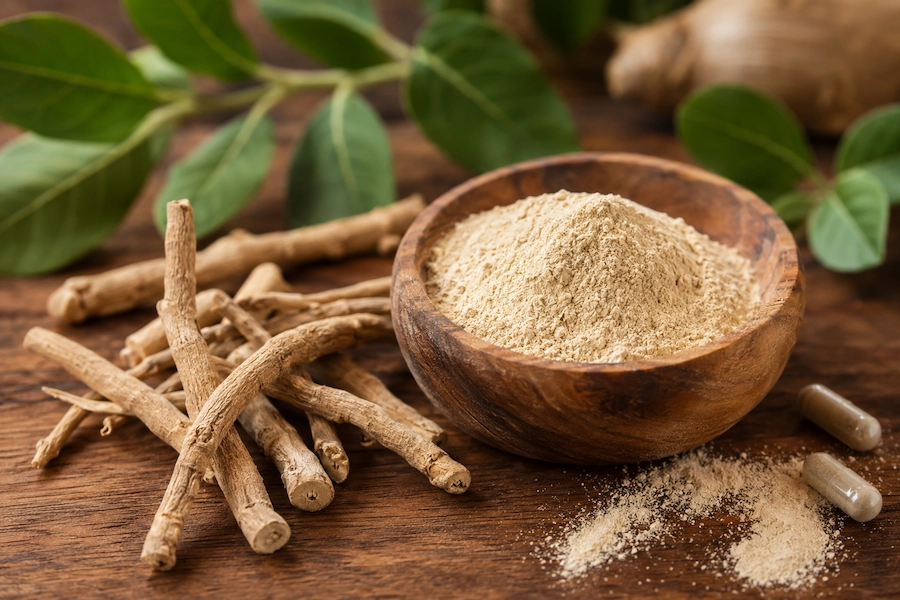
Root powder
This is the dried and ground root of the plant and is the form closest to traditional Ayurvedic use.
- Pros: Minimally processed, contains the whole plant material, and is suitable for traditional use, for example with warm milk or water.
- Cons: Larger amounts need to be taken, it has a distinctive taste, and it is more difficult to compare with most modern clinical studies.
Extract
In an extract, certain constituents of the plant have been extracted and concentrated.
- Pros: Smaller amounts are required, it is convenient to take, and extracts are the form used in a large proportion of modern clinical studies.
- Cons: Different extracts may have very different concentrations. Therefore, 300 mg of one extract is not necessarily equivalent to 300 mg of another.
Standardized extract
With this type of extract, the content of certain plant compounds, such as withanolides, is standardized.
The main advantage is a more consistent composition. However, a higher percentage of withanolides or a larger number of milligrams does not automatically mean a higher-quality product.
Therefore, when comparing products, it is better to ask:
“How many mg of which form of ashwagandha?” rather than simply “How many mg?”
When should you take ashwagandha – morning or evening?
There is no established rule that ashwagandha must be taken at a particular time of day. In practical terms, the timing can be adapted to the intended purpose:
- Morning – when it is used as part of a routine for managing daily stress, fatigue, and physical or mental strain.
- Evening – when the main goal is relaxation and sleep support.
- Morning and evening – dividing the daily amount into two doses is also a well-studied approach. For example, clinical studies on stress have used 300 mg of extract twice daily for approximately 8 weeks.
Consistency and taking ashwagandha for a sufficient period of time appear to be more important than the exact time of day.
Before or after food?
Ashwagandha may cause mild stomach discomfort in some people, so taking it with or after food may be more comfortable.
Of course, the directions for the specific product should always be followed.
Ashwagandha for stress – what does the science say?
Stress is one of the best-studied areas of ashwagandha research.
In clinical studies, taking ashwagandha extract for 6–8 weeks has been associated with reductions in perceived stress and, in some studies, with lower cortisol levels. The NIH notes that in some studies the effects were more pronounced with doses of 500–600 mg per day.
This is also why ashwagandha is classified as an adaptogen – a herb that supports the body's ability to adapt to physical and mental stress.
How should ashwagandha be taken for sleep?
The scientific evidence is interesting here as well.
Studies using different extracts have shown small but statistically significant improvements in measures such as sleep quality, sleep duration, and the time needed to fall asleep. In the NIH review, the effects were more pronounced in people with insomnia when taking approximately 600 mg per day for at least 8 weeks.
This does not mean that ashwagandha acts like a sleeping pill. Rather, its effects tend to develop gradually with regular use.
How long does it take for ashwagandha to work?
Do not expect an effect after taking a single tablet.
Many clinical studies assess results after 6–8 weeks of regular use.
Some people may notice a difference sooner, while for others it may take longer. Ashwagandha makes more sense as part of a regular routine than as a supplement taken only on a particularly stressful day.
How long can ashwagandha be taken?
Most scientific data are available for periods ranging from several weeks to approximately 3 months. There is still insufficient information on the safety of continuous use for many months or years.
This does not mean that a break is necessarily required after exactly 8 or 12 weeks. It simply means that scientific evidence on very long-term use is more limited.
The key points at a glance
- Extract: Clinical studies commonly use around 250–600 mg per day, with 500–600 mg per day being particularly well studied for stress.
- Root powder: Amounts are measured in grams; scientific studies have used the equivalent of approximately 6 g of root powder per day.
- Morning or evening: There is no strict rule. Morning may be practical for daytime stress and strain, while evening may be preferred when the goal is relaxation and sleep.
- How long: Many studies last 6–8 weeks, while the most safety data are available for short-term use of up to approximately 3 months.
- Powder or extract: They cannot be compared directly based on milligrams alone.
- The most important principle: Do not look only at the number of milligrams on the label. Consider how many milligrams, in what form, and at what concentration.
This article is based on published scientific data and reviews from PubMed, the National Institutes of Health (NIH) Office of Dietary Supplements, and the National Center for Complementary and Integrative Health (NCCIH).










Post comment